Complete Glaze Course
Glaze Theory and Practice
A comprehensive glaze course designed to teach you glaze theory and design.
25/10/26 Theory: 13:00-17:00 including glaze application and type of test tiles, choice of base glaze.
8/11/26 & 15/11/2: 13:00-14:00 Practical and Analysis; 14:00-17:00 adjusting glazes and making new tests
22/11/26: 13:00-17:00; Final Assessment and plan for future tests
Price €200 per person Includes all materials (clay, glaze ingredients, kiln firings)
Requirements: A good dust mask and a precision scale (+/-0.01g recommended).
Before starting the second session each person will be provided with 1 kilo of 4 clays to make 20 bisqued test tiles of each. WM, Nigra, Porcelain & Toffee
Here some houserules
Mastering Glazing
Please arrive 15 minutes before the session is due to start
Materials & Glazes
Glaze is magic in both a positive and negative sense. A blessing when a combination of clay, glaze and heat creates beauty and a curse when it fails.
Fascination with glaze and it’s ability to express our deepest felt creativity is a central part of a ceramicists unique voice and vision.
Glaze research and the exploration of how we may achieve our desired results is the basis of this course.
The Science
Modern glazes are designed with science as the touchstone but it has not always been that way. For generations past experimentation with natural minerals and ash was experiential. These 2 approaches are the basis of all glazes. It takes time, experimentation, and many firings to understand how processed and natural materials respond to heat.
Failure is part of this process, but so is discovery.
Your knowledge evolves as your chosen glaze continues to evolve, revealing different surfaces and colours on different clays, thicknesses and combinations.
Glaze course Fall 2026
We will guide you in making and developing your own glazes from scratch and teach the theoretical approach to adjusting and fine tuning glazes to your needs in the future.
We will also help you understand how to decide which glaze application method is best suited to your work and the result your goal.
Theory
We look at what a glaze is, how it behaves, and what to look for in making a stable glaze.
Topics include
colour development,
matt vs glossy surfaces,
glaze quality and
durability (including food and dishwasher safety)
common glaze defects
methods of control and adjustment.
Practical
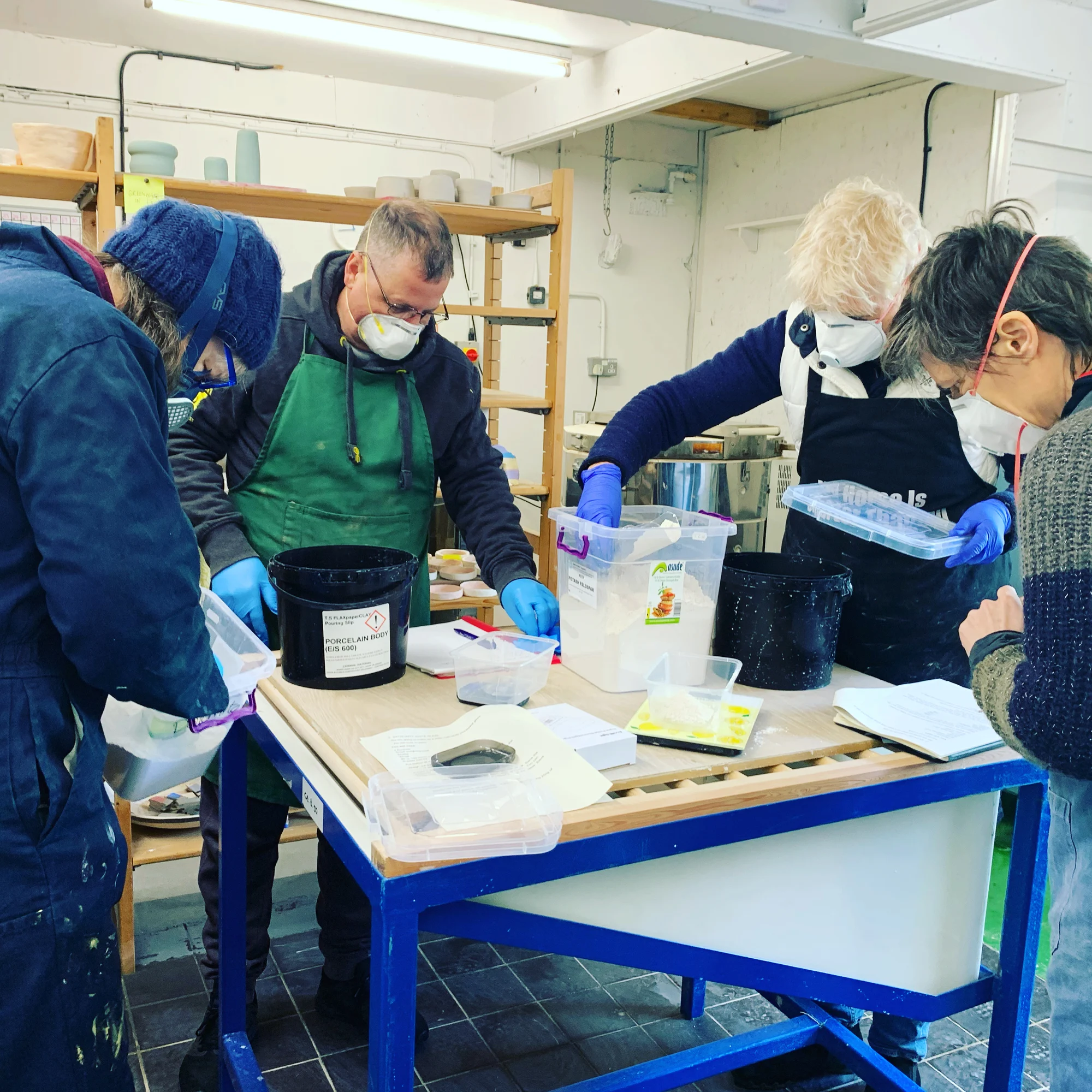
Hands-on testing forms the core of the course.
Mixing and testing glazes on 4 clay bodies, to develop a mid-fire base glaze.
Determining the optimum specific gravity as well as density using measurement and dip testing.
building a structured testing system
using digital tools such as glazy to document and share results.
Analysis
Together we will examine each persons tests, discuss the pros and cons and suggest adjustments to achieve desired changes.
New tests are then made and form the basis of the following sessions discussion.
The course is suitable for both beginners and experienced makers who want to deepen their understanding of glaze development as a material process.